


💡 1

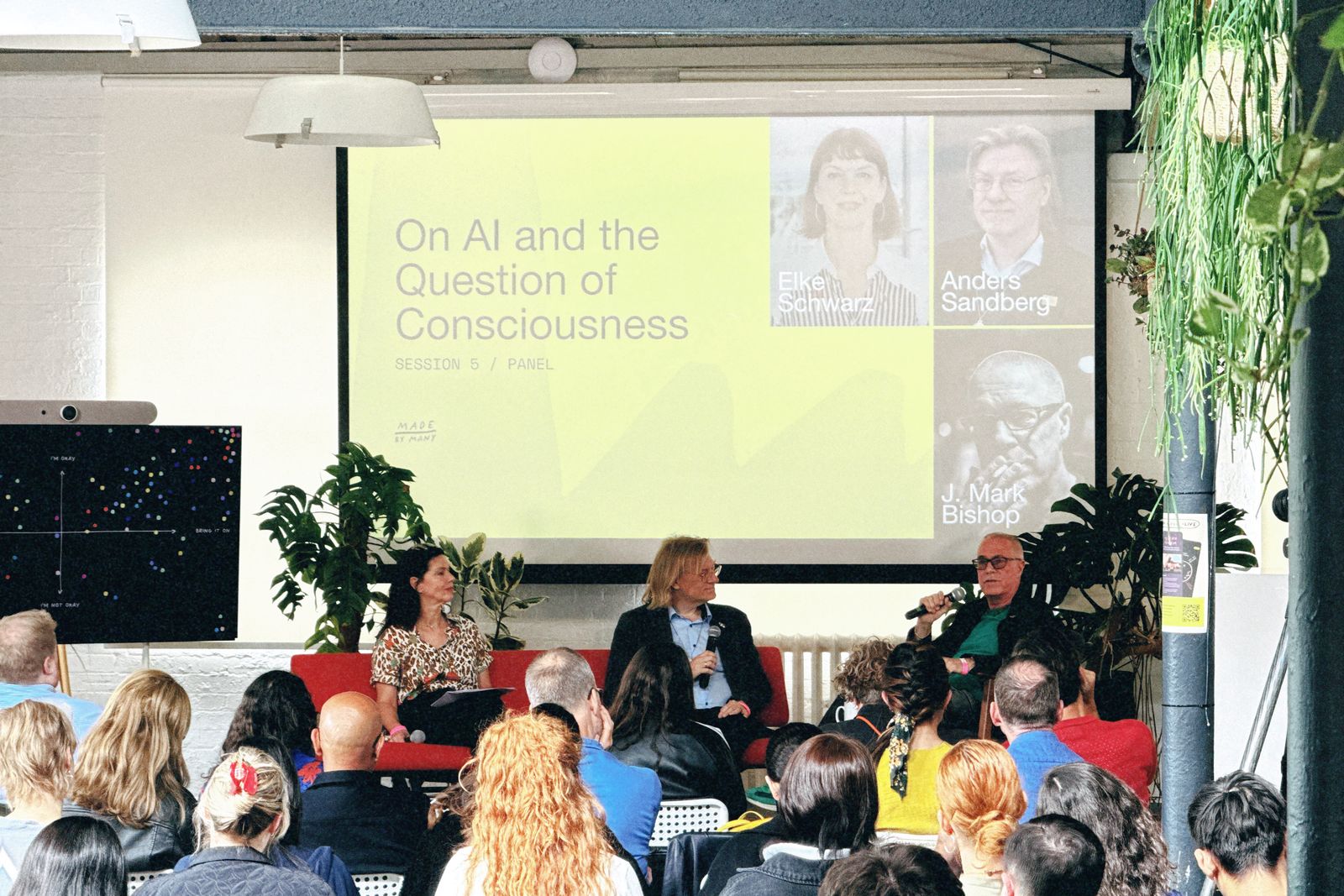
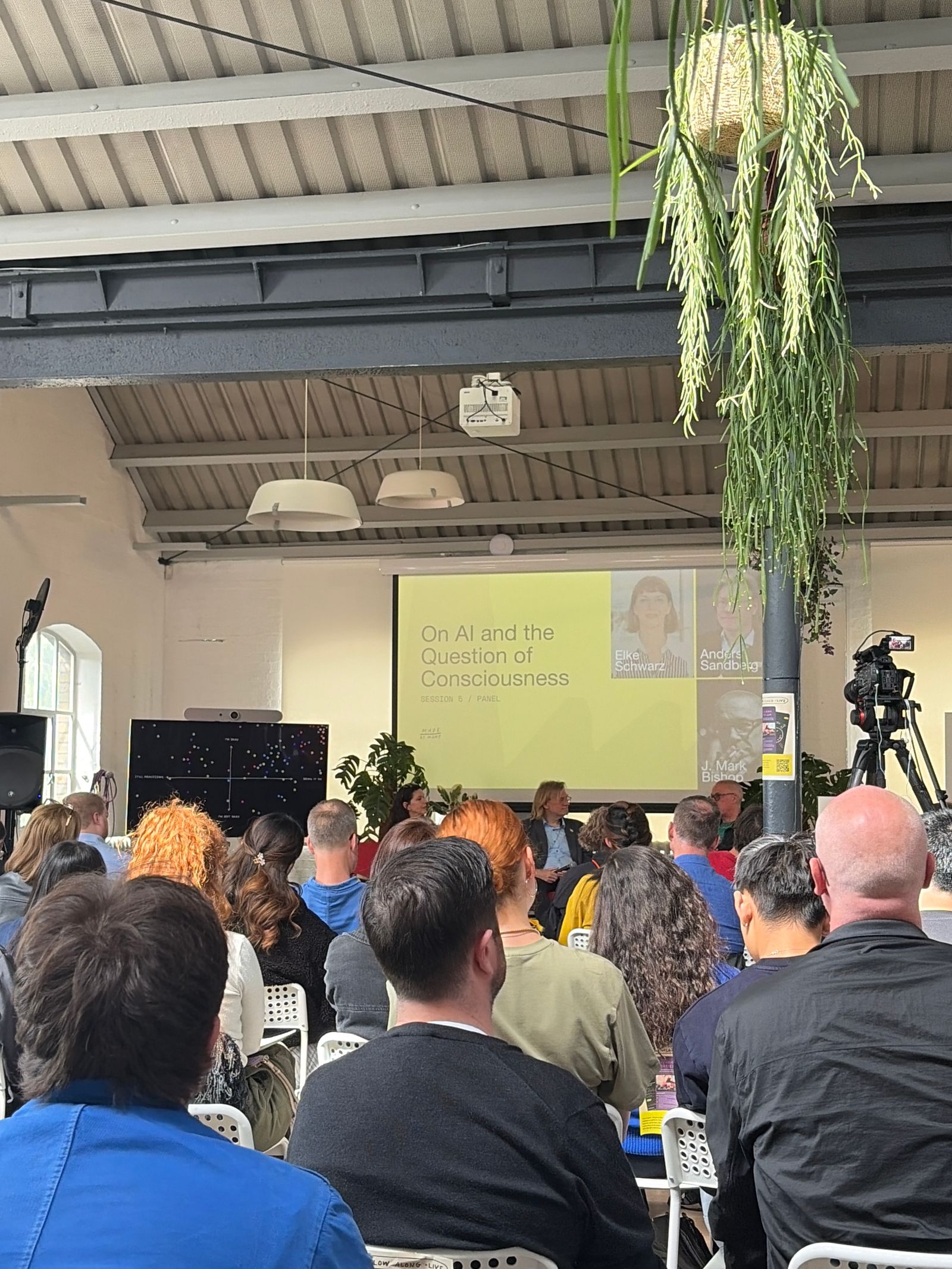
A session with Mark Bishop, Anders Sandberg and Elke Schwarz

On AI and the Question of Consciousness

Mark BishopAnders SandbergElke Schwarz

On AI and the Question of Consciousness

Mark Bishop, Anders Sandberg and Elke Schwarz

This session explored the philosophical divide between functionalist views of AI and the human capacity for genuine, embodied meaning. Experts debated whether machines can ever possess consciousness or if our tendency to project agency onto them is merely a cognitive bias. While AI models mirror human patterns, panelists argued they lack the unified self and lived experience required for true understanding, warning that prioritizing computational efficiency over human autonomy risks undermining the very essence of human thriving.

1 — Can machines truly possess consciousness?

The question of machine consciousness probes whether artificial systems can ever achieve genuine subjective experience or if they are merely sophisticated simulations of human cognition. This inquiry challenges our definitions of mind and agency, forcing a re-evaluation of what it means to be a sentient being in an age of advanced computation.
Insight

A fundamental tension exists between the internal complexity of AI models and their lack of human experience.

While researchers observe AI internal states that mirror human neuroscience and emotional responses, there is a sharp disagreement regarding whether these functional parallels constitute genuine experience or merely misleading imitations of human connection.

2 — Human cognitive bias leads us to project consciousness onto non-conscious systems.

Our brains are hardwired to interpret minimal stimuli, such as two dots and a line, as intentional agents, causing us to reflexively treat AI as a person despite its lack of internal experience. This tendency makes us susceptible to overconfidence in both directions—either assuming machines are conscious or dismissing them as mere numbers.

Insight

Language is a lived, embodied activity that transcends static text.

While large language models process static corpora, human communication—or 'languaging'—is a dynamic, bipartite activity deeply rooted in physical presence, historical context, and bodily expression. The same set of words can carry entirely different meanings depending on the lived experience of the speaker, as seen in the starkly different emotional resonances of the song 'Hurt' when performed by Trent Reznor versus Johnny Cash.

Insight

A fundamental divide separates functionalist and meaning-based views of human cognition.

The debate over AI consciousness hinges on whether human activity is best understood as informatic processing or as a deeply rooted, meaning-making endeavor. This distinction shapes how we project agency onto machines and imagine our future alongside them.

Insight

Computational meaning is not intrinsic to hardware but is assigned by human interpretation.

The logical function of a device, such as an AND gate, is contingent upon the symbolic mapping applied by the user rather than the physical state of the electronics. By inverting the voltage-to-logic mapping, the same physical circuit can perform entirely different operations, demonstrating that meaning is a human-led activity.

3 — Are AI systems clever? Do they understand anything?

Treating LLMs as intelligent entities is dangerous because they lack genuine comprehension and merely mirror the patterns they are fed.

“Who programmed that context shift?”

Insight

Large language models lack the capacity for genuine speech acts like promising.

These systems lack a unified self and the moral motivation to bind their future behavior, their declarations are essentially hollow. They function as air rather than as commitments that carry social or ethical weight.

Insight

Societies may prioritize AI-driven efficiency at the expense of human autonomy.

The integration of AI into governance could lead to prosperous, stable societies that render individual agency obsolete, relegating it to a quaint, non-essential hobby. This shift threatens human thriving, which fundamentally requires the experience of being in charge of one's own life.

4 — Can the development of artificial intelligence be safeguarded to ensure broad societal benefit rather than the enrichment of a few?

The history of transformative ideas shows a recurring pattern where innovations intended for the public good are co-opted by vested interests to consolidate power and wealth. As AI companies reach unprecedented market valuations, there is an urgent need to decouple technological progress from existing power dynamics that prioritize capital accumulation over justice and equality.

Insight

Phenomenal consciousness is an intrinsic, elemental aspect of human existence.

The experience of sensations like pain or pleasure is not a theoretical puzzle but a fundamental reality of being alive that is immediately accessible to us. (We know what phenomenal consciousness is.)

Insight

Meaning is an interpretive act performed by humans rather than an intrinsic property of computational signals.

While machines process voltages and signals, the symbolic meaning attributed to those outputs is a human projection. Even if a system appears to discuss complex topics like religion, it remains a mechanical process devoid of internal understanding.

0%
Back to programme